Robust RL Differential Game Guidance
Robust Reinforcement Learning Differential Game Guidance
Master’s Thesis — Low-Thrust Multi-Body Dynamical Environments
Ali Bani Asad
Department of Aerospace Engineering, Sharif University of Technology
Supervised by: Dr. Hadi Nobahari · September 2025





📋 Abstract
This research presents a zero-sum multi-agent reinforcement learning (MARL) framework for robust spacecraft guidance in the challenging Earth-Moon three-body dynamical system. The work addresses critical problems in low-thrust spacecraft guidance under significant environmental uncertainties through a novel differential game formulation.
Multi-Agent RL: Robust spacecraft guidance in three-body problem
🎯 Key Contributions
- 🎮 Zero-Sum Game Formulation — Spacecraft guidance cast as a two-player differential game between guidance and disturbance agents.
- 🤖 Multi-Agent RL Algorithms — DDPG, TD3, SAC, and PPO extended to zero-sum MARL variants (MA-DDPG, MA-TD3, MA-SAC, MA-PPO).
- 🛡️ Robustness Analysis — Extensive stress-testing across initial conditions, actuator disturbances, sensor noise, delays, model mismatch, and combined uncertainties.
- 🚀 Hardware Integration — ROS2 pipeline with C++ inference for real-time deployment.
- 📊 Benchmark Comparison — Classical control and single-agent RL baselines for rigorous evaluation.
🏆 Key Results
The zero-sum MARL approach demonstrates superior robustness, highlighted by MA-TD3 performance:
- ✅ 30 % trajectory error reduction versus single-agent TD3
- ✅ 95.3 % success rate under combined uncertainties (vs. 88.2 %)
- ✅ 23.4 m/s fuel consumption — lowest among all methods
- ✅ <5 ms C++ inference time enabling real-time execution
- ✅ Stable behavior even in heavily perturbed environments
🏗️ Repository Structure
master-thesis/
├── 📚 Report/                      # LaTeX thesis document
│   ├── thesis.tex                  # Main thesis file
│   ├── Chapters/                   # 8 chapters (Introduction → Conclusion)
│   ├── bibs/                       # Bibliography
│   └── plots/                      # Result plots and figures
│
├── 📜 Paper/                       # Conference paper (IEEE format)
│
├── 💻 Code/
│   ├── Python/
│   │   ├── Algorithms/             # DDPG, TD3, SAC, PPO implementations
│   │   ├── Environment/            # Three-body problem dynamics (TBP.py)
│   │   ├── TBP/                    # Single-agent training
│   │   ├── Robust_eval/            # Robustness testing (Standard & ZeroSum)
│   │   ├── Benchmark/              # OpenAI Gym environments
│   │   └── utils/                  # Utility functions
│   │
│   ├── C/                          # C++ real-time inference (PyTorch models)
│   ├── ROS2/                       # ROS2 packages for hardware integration
│   ├── Simulink/                   # MATLAB Simulink models
│   └── ros_legacy/                 # Legacy ROS1 implementation
│
├── 🖼️ Figure/                      # Visualizations (TBP, HIL)
├── 🎓 Presentation/                # Defense slides (Beamer)
└── 📖 Proposal/                    # Research proposal
Full Repository: https://github.com/alibaniasad1999/master-thesis
🔬 Research Methodology
Problem Formulation
The spacecraft guidance problem in the Circular Restricted Three-Body Problem (CR3BP) is formulated as a zero-sum differential game:
🎯 Player 1: Guidance Agent
Minimizes trajectory deviation and fuel consumption
⚔️ Player 2: Disturbance Agent
Maximizes trajectory deviation (models worst-case uncertainties)
This formulation enables the development of inherently robust control policies that perform well under adversarial conditions.
🤖 Multi-Agent RL Algorithms
| Algorithm | Type | Key Features | Best For |
|---|---|---|---|
| MA-DDPG | Off-policy, Deterministic | Simple, efficient, strong baseline | Fast prototyping |
| MA-TD3 | Off-policy, Deterministic | Target smoothing, delayed updates, clipped double Q | Best overall performance |
| MA-SAC | Off-policy, Stochastic | Maximum entropy, automatic temperature tuning | Exploration-heavy tasks |
| MA-PPO | On-policy, Stochastic | Trust-region optimization, stable updates | Sparse rewards |
Training Strategy
- Centralized Training, Decentralized Execution (CTDE): Both agents observe full state during training but act independently during deployment
- Alternating Optimization: Sequential training of guidance and disturbance agents
- Full Information Setting: Complete state observation for optimal policy learning
📊 Key Results
Performance Comparison
| Algorithm | Trajectory Error (m) | Fuel Consumption (m/s) | Success Rate (%) | Robustness |
|---|---|---|---|---|
| PID Control | 8,432 ± 2,156 | 45.2 ± 8.3 | 72.4 | ⭐⭐ |
| DDPG | 1,234 ± 892 | 28.7 ± 5.2 | 84.6 | ⭐⭐⭐ |
| TD3 | 967 ± 654 | 26.4 ± 4.1 | 88.2 | ⭐⭐⭐⭐ |
| SAC | 1,045 ± 721 | 27.8 ± 4.8 | 86.9 | ⭐⭐⭐⭐ |
| PPO | 1,398 ± 978 | 31.2 ± 6.3 | 81.5 | ⭐⭐⭐ |
| MA-DDPG | 892 ± 423 | 25.1 ± 3.2 | 91.7 | ⭐⭐⭐⭐ |
| MA-TD3 🏆 | 687 ± 312 | 23.4 ± 2.8 | 95.3 | ⭐⭐⭐⭐⭐ |
| MA-SAC | 734 ± 367 | 24.2 ± 3.1 | 93.8 | ⭐⭐⭐⭐⭐ |
| MA-PPO | 856 ± 445 | 26.7 ± 3.9 | 90.4 | ⭐⭐⭐⭐ |
Results averaged over 1,000 test episodes with combined uncertainty scenarios.
Trajectory Tracking Performance: TD3
Standard vs Zero-Sum MA-TD3 Comparison
Standard TD3 Trajectory

Zero-Sum MA-TD3 Trajectory

Standard TD3 with Control Forces

Zero-Sum MA-TD3 with Control Forces

Key Observation: MA-TD3 maintains tighter trajectories with smaller control-effort fluctuations than standard TD3 in the same scenarios.
Robustness Analysis Under Uncertainty
Comparative Performance: All Four Algorithms
The violin plots below show the performance distribution of all four RL algorithms (DDPG, TD3, SAC, PPO) under various uncertainty scenarios. Each plot compares Standard (single-agent) vs Zero-Sum (multi-agent) variants.
Zero-Sum Multi-Agent RL - All Algorithms Combined
Actuator Disturbance

Sensor Noise

Initial Condition Shift

Time Delay

Model Mismatch

Partial Observation

Standard Single-Agent RL - All Algorithms Combined
Actuator Disturbance

Sensor Noise

Initial Condition Shift

Time Delay

Model Mismatch

Partial Observation

🎯 Key Findings
✅ Zero-sum MARL outperforms single-agent RL across every metric
✅ MA-TD3 offers ~30 % error reduction versus TD3
✅ Robustness improves across all uncertainty classes with narrower performance distributions
✅ Real-time deployment is feasible thanks to sub-5 ms inference latency
🚀 Getting Started
Prerequisites
Software Requirements:
- Python 3.8 or higher
- PyTorch 2.2.2
- CUDA 11.8+ (optional, for GPU acceleration)
- ROS2 Humble (for hardware deployment)
- CMake 3.16+ (for C++ implementation)
- LaTeX distribution (for compiling thesis document)
Hardware Requirements:
- 16+ GB RAM (recommended for training)
- NVIDIA GPU with 6+ GB VRAM (optional, speeds up training significantly)
Installation
1. Clone the Repository
git clone https://github.com/alibaniasad1999/master-thesis.git
cd master-thesis
2. Set Up Python Environment
# Create virtual environment
python -m venv venv

# Activate virtual environment
source venv/bin/activate  # Linux/macOS
# or
venv\Scripts\activate  # Windows

# Install dependencies
pip install -r requirements.txt
3. Verify Installation
python -c "import torch; import gymnasium; import numpy; print('✓ All packages installed successfully')"
💡 Usage Guide
Training RL Agents
Single-Agent Training (Baseline)
cd Code/Python/TBP/SAC
jupyter notebook SAC_TBP.ipynb
Follow the notebook to:
- Configure environment parameters
- Set hyperparameters
- Train the agent
- Evaluate performance
- Save trained models
Zero-Sum Multi-Agent Training
cd Code/Python/TBP/SAC/ZeroSum
jupyter notebook Zero_Sum_SAC_TBP.ipynb
The notebook demonstrates:
- Zero-sum game setup
- Alternating training procedure
- Nash equilibrium convergence
- Robustness evaluation
Robustness Evaluation
cd Code/Python/Robust_eval/ZeroSum/sensor_noise
jupyter notebook sensor_noise.ipynb
This evaluates trained policies under sensor noise perturbations and generates comparison plots.
C++ Inference (Real-Time Deployment)
cd Code/C
mkdir build && cd build
cmake ..
make
./main
The C++ implementation loads PyTorch traced models for fast inference.
ROS2 Integration
cd Code/ROS2
colcon build
source install/setup.bash
ros2 launch tbp_rl_controler tbp_system.launch.py
This launches:
- Three-body dynamics simulator node
- RL controller node
- Data logging node
🎓 Why Multi-Agent & Zero-Sum?
Many real-world control problems are effectively games:
- 🎯 Pursuit-evasion – interceptor vs. target aircraft, autonomous car vs. pedestrian prediction
- 🌪️ Disturbance rejection – controller vs. nature; treat wind-gusts or hardware faults as an adversary
- 🤝 Competitive resource allocation – multiple robots vying for the same power or bandwidth budget
Model-free RL lifts the need for hand-crafted opponent models; differential-game extensions push agents toward robust Nash equilibria, not brittle one-shot optima.
📚 Reinforcement Learning — Quick Primer
Reinforcement learning (RL) is a paradigm in which an agent discovers an optimal control policy by interacting with an environment and maximising cumulative reward.
Fundamentals
At each discrete time $t$ the agent:
- Observes a state $s_t$
- Acts using policy $a_t\sim\pi_\theta(\,\cdot\,\mid s_t)$
- Receives a reward $r_t$ and the next state $s_{t+1}$
This loop repeats until a terminal condition resets the episode.
Conceptually, the environment, agent, and action align with the classic control terms plant, controller, and control input.
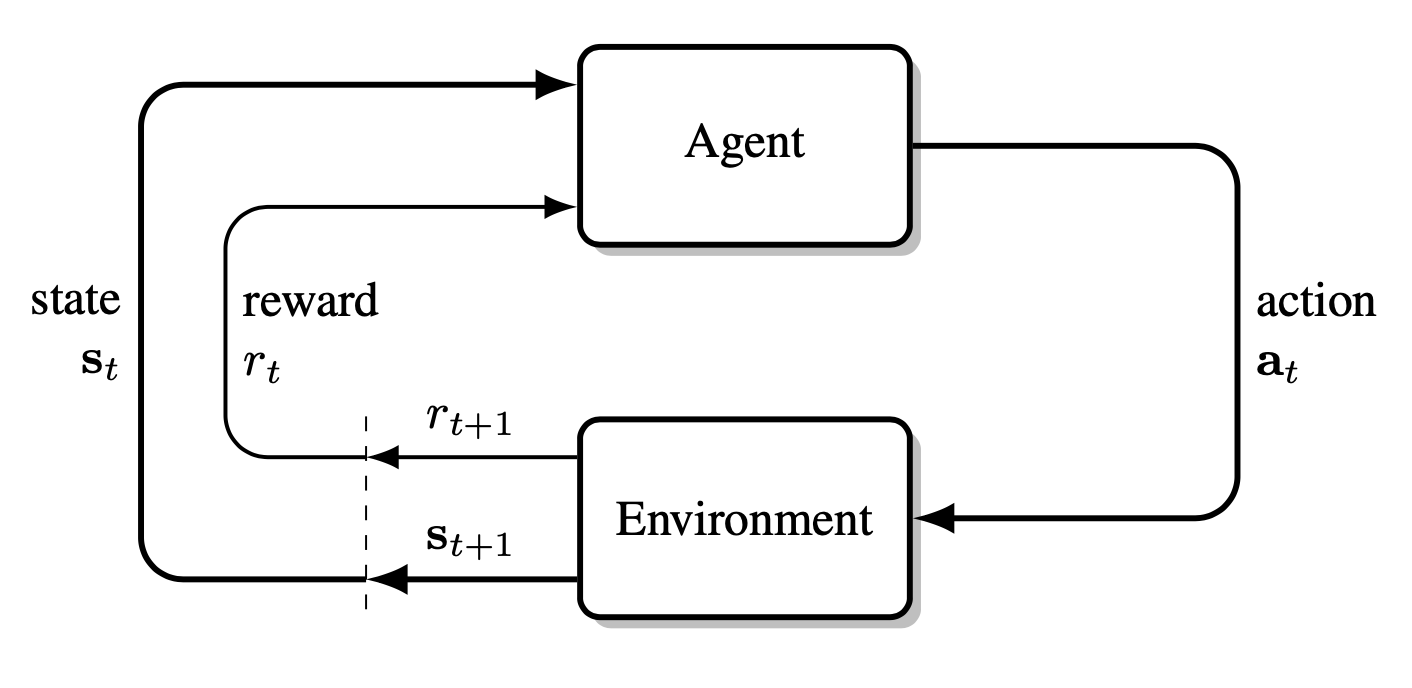
The agent–environment process in a Markov decision process
Mathematically, the problem is cast as a Markov Decision Process (MDP)
$\langle S,A,P,r,q_0,\gamma\rangle$:
- $S,\;A$ – state and action sets
- $P(s’\mid s,a)$ – transition kernel
- $r(s)\in\mathbb R$ – reward
- $q_0$ – initial-state distribution
- $\gamma\in[0,1]$ – discount factor
The agent seeks to maximise the expected return
\[G_t=\sum_{k=t+1}^{T}\gamma^{\,k-t-1}r_k.\]Value functions formalise “how good” a state or action is:
\[\begin{aligned} V^\pi(s_t) &=\mathbb E_\pi\Bigl[G_t\mid s_t\Bigr],\\[2pt] Q^\pi(s_t,a_t) &=\mathbb E_\pi\Bigl[G_t\mid s_t,a_t\Bigr]. \end{aligned}\]📖 Algorithms
Actor–Critic Frameworks & Neural Networks
Most modern continuous-control algorithms are actor–critic:
- Actor $\pi_{\theta}(a\mid s)$ – the policy
- Critic $Q_{\phi}$ or $V_{\psi}$ – estimates return
Both are neural networks (fully-connected, ReLU) trained with gradient-based updates.
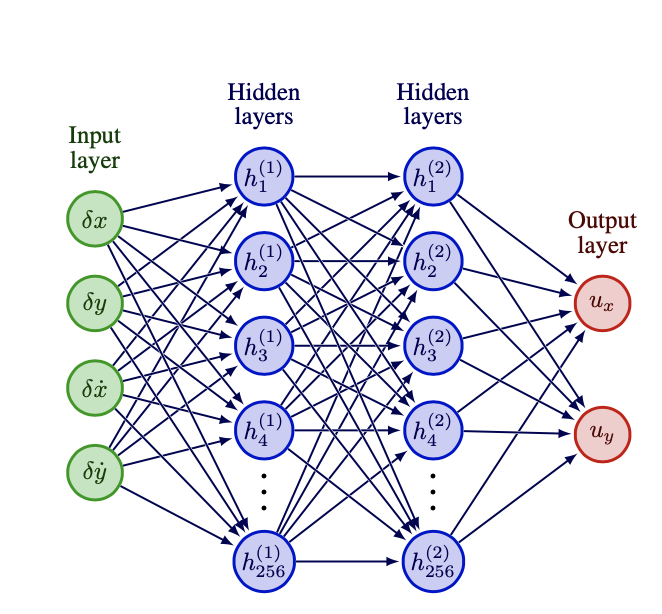
Actor network (policy)
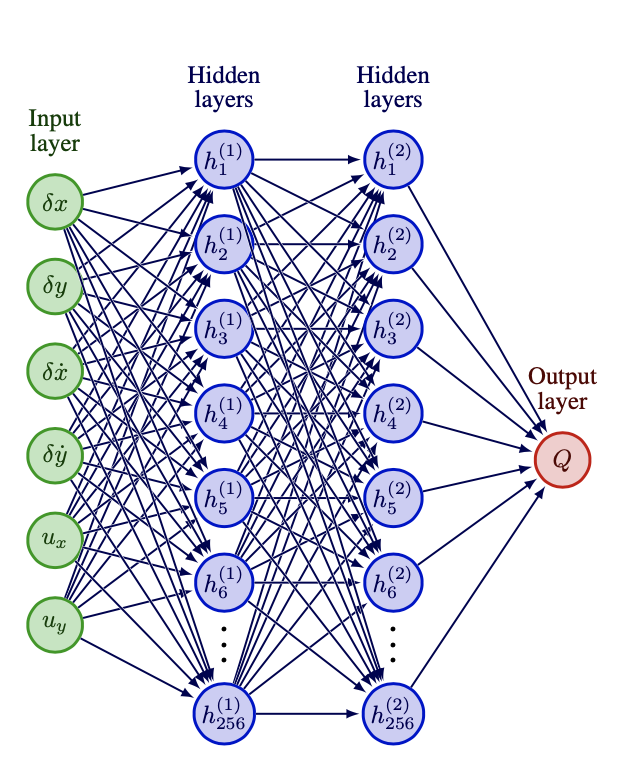
Critic network (value)
DDPG Algorithm (Deep Deterministic Policy Gradient, Multi-Agent Zero-Sum)
- Input: initial policy parameters $\theta_1$, $\theta_2$, Q-function parameters $\phi_1$, $\phi_2$, empty replay buffer $\mathcal{D}$
- Set target parameters equal to main parameters $\theta_{\text{targ},1} \leftarrow \theta_1$, $\theta_{\text{targ},2} \leftarrow \theta_2$, $\phi_{\text{targ},1} \leftarrow \phi_1$, $\phi_{\text{targ},2} \leftarrow \phi_2$
- Repeat:
- Observe state $s$
- Select action for player 1: $a_1 = \text{clip}(\mu_{\theta_1}(s) + \epsilon_1, a_{Low}, a_{High})$, where $\epsilon_1 \sim \mathcal{N}$
- Select action for player 2: $a_2 = \text{clip}(\mu_{\theta_2}(s) + \epsilon_2, a_{Low}, a_{High})$, where $\epsilon_2 \sim \mathcal{N}$
- Execute actions $(a_1, a_2)$ in the environment
- Observe next state $s’$, reward pair $(r_1, r_2)$ for both players, and done signal $d$
- Store transition $(s, a_1, a_2, r_1, r_2, s’, d)$ in replay buffer $\mathcal{D}$
- If $s’$ is terminal: Reset environment state
- If it’s time to update:
- For j in range (however many updates):
- Randomly sample a batch of transitions, $B = { (s, a_1, a_2, r_1, r_2, s’, d) }$ from $\mathcal{D}$
- Compute targets for both players:
- $y_1 = r_1 + \gamma (1 - d) Q_{\phi_{\text{targ},1}}(s’, \mu_{\theta_{\text{targ},1}}(s’), \mu_{\theta_{\text{targ},2}}(s’))$
- $y_2 = r_2 + \gamma (1 - d) Q_{\phi_{\text{targ},2}}(s’, \mu_{\theta_{\text{targ},1}}(s’), \mu_{\theta_{\text{targ},2}}(s’))$
- Update Q-functions for both players by one step of gradient descent:
-
$\nabla_{\phi_1}\,\frac{1}{ B }\sum_{(s,a_1,a_2,r_1,s^{\prime},d)\in B}\bigl(Q_{\phi_1}(s,a_1,a_2)\;-\;y_1\bigr)^{2}$ -
$\nabla_{\phi_2}\,\frac{1}{ B }\sum_{(s,a_1,a_2,r_2,s^{\prime},d)\in B}\bigl(Q_{\phi_2}(s,a_1,a_2)\;-\;y_2\bigr)^{2}$
-
- Update policies for both players by one step of gradient ascent:
-
$\nabla_{\theta_1}\,\frac{1}{ B }\sum_{s\in B}Q_{\phi_1}\bigl(s,\mu_{\theta_1}(s),\mu_{\theta_2}(s)\bigr)$ -
$\nabla_{\theta_2}\,\frac{1}{ B }\sum_{s\in B}Q_{\phi_2}\bigl(s,\mu_{\theta_1}(s),\mu_{\theta_2}(s)\bigr)$
-
- Update target networks for both players:
- $\phi_{\text{targ},1} \leftarrow \rho \phi_{\text{targ},1} + (1 - \rho) \phi_1$
- $\phi_{\text{targ},2} \leftarrow \rho \phi_{\text{targ},2} + (1 - \rho) \phi_2$
- $\theta_{\text{targ},1} \leftarrow \rho \theta_{\text{targ},1} + (1 - \rho) \theta_1$
- $\theta_{\text{targ},2} \leftarrow \rho \theta_{\text{targ},2} + (1 - \rho) \theta_2$
- For j in range (however many updates):
- Until convergence
TD3 Algorithm (Twin Delayed Deep Deterministic Policy Gradient, Multi-Agent Zero-Sum)
- Input: initial policy parameters $\theta_1,\theta_2$, twin-critic parameters
${\phi_{1,1},\phi_{1,2}}$ and ${\phi_{2,1},\phi_{2,2}}$, empty replay buffer $\mathcal D$ - Set targets:
$\theta_{\text{targ},i}\leftarrow\theta_i,\;\; \phi_{\text{targ},i,j}\leftarrow\phi_{i,j}\quad (i\in{1,2},\,j\in{1,2})$ - Repeat
- Observe state $s$
- Action selection
$a_i=\operatorname{clip}\bigl(\mu_{\theta_i}(s)+\epsilon_i,\;a_{\min},a_{\max}\bigr),\; \epsilon_i\sim\mathcal N\quad (i=1,2)$ - Execute $(a_1,a_2)$; observe $s’$, reward pair $(r,-r)$, done $d$
- Store $(s,a_1,a_2,r,s’,d)$ in $\mathcal D$
- Every $M$ steps do: (for each update iteration $j$)
- Sample mini-batch $B\subset\mathcal D$
- Target actions (policy smoothing)
$\tilde a_i = \operatorname{clip}\bigl(\mu_{\theta_{\text{targ},i}}(s’) +
\operatorname{clip}(\eta_i,-c,c),\,a_{\min},a_{\max}\bigr),\;\eta_i\sim\mathcal N$ - Target Q-values (use minimum of twins)
$y = r + \gamma(1-d)\,\min_{j}\,Q_{\phi_{\text{targ},1,j}}\bigl(s’,\tilde a_1,\tilde a_2\bigr)$
(player 2 receives $-y$) - Critic updates $(j=1,2)$:
$\nabla_{\phi_{i,j}}\;\frac1{|B|}\sum_{B}\bigl(Q_{\phi_{i,j}}(s,a_1,a_2)-\sigma_i\,y\bigr)^2$
with $\sigma_1=+1,\;\sigma_2=-1$ - Delayed actor update (every $d_{\text{policy}}$ iterations)
$\nabla_{\theta_i}\;\frac1{|B|}\sum_{s\in B}Q_{\phi_{i,1}}(s,\mu_{\theta_1}(s),\mu_{\theta_2}(s))$ - Target-network Polyak averaging
$\phi_{\text{targ},i,j}\leftarrow\tau\phi_{i,j}+(1-\tau)\phi_{\text{targ},i,j}$
$\theta_{\text{targ},i}\leftarrow\tau\theta_i+(1-\tau)\theta_{\text{targ},i}$
- Until convergence
SAC Algorithm (Soft Actor-Critic, Multi-Agent Zero-Sum)
- Input: policy parameters $\theta_1,\theta_2$, twin critics ${\phi_{1,1},\phi_{1,2}}$,
${\phi_{2,1},\phi_{2,2}}$, temperature parameters $\alpha_1,\alpha_2$, replay buffer $\mathcal D$ - Initialise target critics $\phi_{\text{targ},i,j}\leftarrow\phi_{i,j}$
- Repeat
- Observe state $s$
- Sample actions (re-parameterisation):
$a_i=\tanh\bigl(\mu_{\theta_i}(s)+\sigma_{\theta_i}(s)\,\epsilon_i\bigr),\;\epsilon_i\sim\mathcal N$ - Execute $(a_1,a_2)$; observe $s’$, reward $(r,-r)$, done $d$
- Store transition in $\mathcal D$
- For $j=1\ldots N_{\text{updates}}$:
- Sample mini-batch $B$
- Target value with entropy bonus
$\tilde a_i’\sim\pi_{\theta_i}(s’),quad
\hat Q_{i}(s’,\tilde a_1’,\tilde a_2’)=\min_{k}Q_{\phi_{\text{targ},i,k}}(s’,\tilde a_1’,\tilde a_2’)$ - $y = r + \gamma(1-d)\bigl(\hat Q_{1}(s’,\cdot) - \alpha_1\log\pi_{\theta_1}(\tilde a_1’|s’)\bigr)$
(player 2 uses $-y$ with $\alpha_2$) - Critic losses
$\mathcal L_{\phi_{i,k}}=\frac1{|B|}\sum_{B}\bigl(Q_{\phi_{i,k}}(s,a_1,a_2)-\sigma_i\,y\bigr)^2$ - Policy losses
$\mathcal L_{\theta_i}=\frac1{|B|}\sum_{s\in B}
\bigl(\alpha_i\log\pi_{\theta_i}(a_i|s)-Q_{\phi_{i,1}}(s,a_1,a_2)\bigr)$ - Temperature update (optional, per player)
$\nabla_{\alpha_i}\;\alpha_i\bigl(-\log\pi_{\theta_i}(a_i|s)-\mathcal H_\text{target}\bigr)$ - Target critics
$\phi_{\text{targ},i,k}\leftarrow\tau\phi_{i,k}+(1-\tau)\phi_{\text{targ},i,k}$
- Until convergence
PPO Algorithm (Proximal Policy Optimisation, Multi-Agent Zero-Sum)
- Input: policy parameters $\theta_1,\theta_2$, critic parameters $\psi_1,\psi_2$
- Repeat
- Collect trajectories for $T$ steps using current policies $\pi_{\theta_1},\pi_{\theta_2}$
- For each step $t$ compute
- Returns: $G_t^1 = \sum_{k\ge t}\gamma^{k-t}r_k$, $G_t^2=-G_t^1$
- Advantages:
$A_t^i = G_t^i - V_{\psi_i}(s_t)$
- For $K$ epochs, minibatch over collected data:
- Ratio:
$r_t^i(\theta) = \dfrac{\pi_{\theta_i}(a_t|s_t)}{\pi_{\theta_{i,\text{old}}}(a_t|s_t)}$ - Clipped objective:
$\mathcal L_{\theta_i}=
\frac1{|B|}\sum_{t\in B}\min\bigl(r_t^iA_t^i,\;\operatorname{clip}(r_t^i,1-\epsilon,1+\epsilon)A_t^i\bigr)$ - Critic loss:
$\mathcal L_{\psi_i}= \frac1{|B|}\sum_{t\in B}\bigl(V_{\psi_i}(s_t)-G_t^i\bigr)^2$ - Update $\theta_i$ and $\psi_i$ via gradient ascent / descent
- Ratio:
- Until convergence
Notation Key
- $\theta_i$ — actor parameters for player $i$
- $\phi_{i,j}$ — $j$-th Q-critic for player $i$ (TD3/SAC)
- $\psi_i$ — state-value net for player $i$ (PPO)
- $\gamma$ — discount factor
- $\tau$ — Polyak coefficient
- $\epsilon$ — PPO clip range
🎯 Reproducibility
Reproduce Training Results
# Train MA-TD3 agent
cd Code/Python/TBP/TD3/ZeroSum
jupyter notebook Zero_Sum_TD3_TBP.ipynb
# Execute all cells
Reproduce Evaluation Results
# Run robustness evaluation
cd Code/Python/Robust_eval/ZeroSum/All_in_one/actuator_disturbance
jupyter notebook all_in_one.ipynb
Random Seeds
All experiments use fixed random seeds for reproducibility:
- NumPy:
np.random.seed(42) - PyTorch:
torch.manual_seed(42) - Gymnasium:
env.seed(42)
📚 Citation
If you use this work in your research, please cite:
@mastersthesis{baniasad2025robust,
  author       = {Ali Bani Asad},
  title        = {Robust Reinforcement Learning Differential Game Guidance
                  in Low-Thrust, Multi-Body Dynamical Environments},
  school       = {Sharif University of Technology},
  year         = {2025},
  address      = {Tehran, Iran},
  month        = {September},
  type         = {Master's Thesis},
  note         = {Department of Aerospace Engineering}
}
📧 Contact
Ali Bani Asad
Department of Aerospace Engineering, Sharif University of Technology
📧 ali_baniasad@ae.sharif.edu
🔗 @alibaniasad1999Supervisor — Dr. Hadi Nobahari
📧 nobahari@sharif.edu
🙏 Acknowledgments
This research was conducted at the Sharif University of Technology, Department of Aerospace Engineering, under the supervision of Dr. Hadi Nobahari and the advisory of Dr. Seyed Ali Emami Khooansari.
Special thanks to:
- The Aerospace Engineering Department for providing computational resources
- The open-source RL community for excellent libraries and tools
- Colleagues and fellow researchers for valuable discussions and feedback
📜 License
This project is licensed under the MIT License - see the LICENSE file for details.
🔗 Related Resources
- PyTorch: https://pytorch.org/
- Gymnasium: https://gymnasium.farama.org/
- ROS2: https://docs.ros.org/en/humble/
- Stable-Baselines3: https://stable-baselines3.readthedocs.io/
- Three-Body Problem: https://en.wikipedia.org/wiki/Three-body_problem
⭐ If you find this research useful, please consider giving it a star! ⭐
Made with ❤️ at Sharif University of Technology